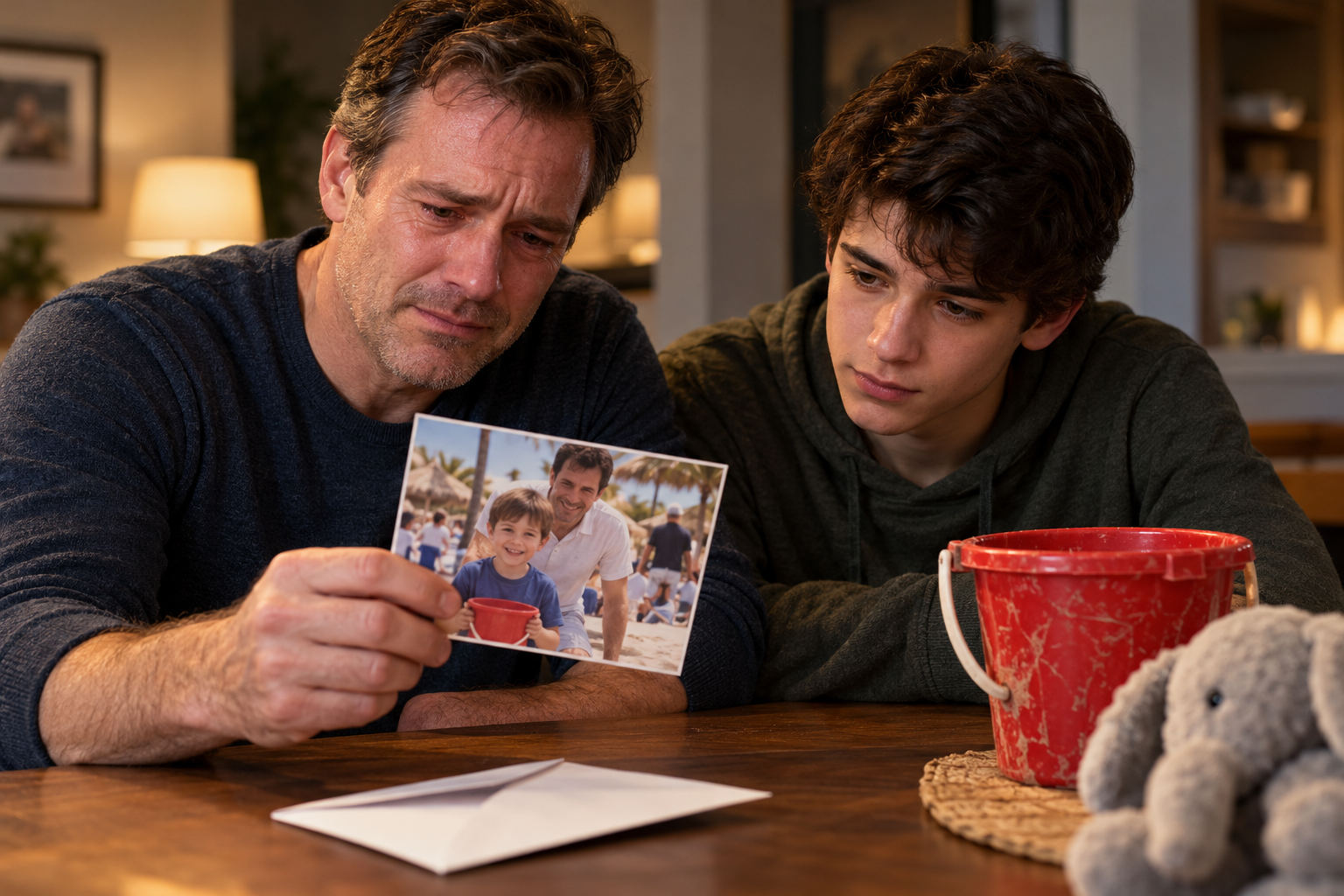
Matthew agreed to meet me again a few days later.
I arrived early, as usual.
I had begun to recognize the small waiting room, the chairs near the window, and the sound of footsteps in the corridor.
The familiarity should have comforted me.
Instead, it reminded me how quickly a strange place could become part of a life.
I had spent eleven years visiting places connected to Matthew's disappearance.
Now I was visiting a place where I could see him again.
That difference mattered more than I could explain.
When he entered, he looked tired.
I asked whether he wanted to sit somewhere else.
He said the room was fine.
We took our usual seats.
I did not bring the photograph.
I did not mention Robert immediately.
I asked Matthew how he was feeling.
He said he wasn't sure.
I understood that answer better than I wanted to.
I had spent years trying to find a clear description for my own grief.
Sometimes I had been angry.
Sometimes I had been numb.
Sometimes I had felt almost normal, then been overwhelmed by a memory I hadn't expected.
There had never been one feeling that explained everything.
I told Matthew that he didn't have to pretend he was fine with me.
He looked at the table.
"I'm not used to this."
"Neither am I."
He gave a small nod.
For a little while, we spoke about ordinary things.
I told him that I had kept some of his belongings.
He asked about the red bucket again.
I said it was still at home.
He wondered whether it would fit on a shelf.
I told him that it probably would.
The conversation was small and awkward.
I treasured it anyway.
I had spent years imagining what I would say to my son if I ever found him.
Most of those imagined conversations had been about the past.
I had forgotten that we would also need to talk about ordinary things.
What he liked.
What he disliked.
What made him laugh.
What he wanted from the future.
I knew none of those things anymore.
I would have to learn them.
After a while, Matthew asked whether I had spoken to Robert.
I told him that we had talked on the telephone.
He asked what Robert had said.
I explained that Robert remembered the day Matthew disappeared, but he had not given me an explanation that answered all my questions.
Matthew listened.
I told him that I had asked why Robert was near the pool when I returned.
He had said the afternoon was chaotic.
I told Matthew that I had asked whether there was anything Robert had never told me.
He had not given me a clear answer.
Matthew's expression remained still.
I could not tell whether he was surprised.
I asked whether he wanted to talk about Robert.
He said he wasn't ready to explain anything.
I nodded.
I did not ask him to explain.
The silence that followed felt different from the silences we had shared before.
It did not feel like an empty space I needed to fill.
It felt like a boundary I needed to respect.
I told him that I would keep asking the questions I needed to ask.
I also told him that I would not force him to answer questions he wasn't ready to discuss.
He looked at me.
"Why are you doing that?"
I was not sure what he meant.
"Doing what?"
"Waiting."
I thought about the question.
For eleven years, I had waited because I believed there was nothing else I could do.
Now I was waiting because I understood that Matthew needed room to decide what he could share.
Those were different kinds of waiting.
"Because I don't want to make you feel like you owe me an explanation."
He looked down.
I continued carefully.
"You were the one who disappeared. You shouldn't have to carry all the responsibility for explaining it."
I saw his fingers tighten against one another.
I stopped speaking.
I did not know whether I had said too much.
After a moment, he looked at me again.
"I don't know what I remember."
I nodded.
"That's all right."
He seemed to struggle with the next words.
Then he said that there were things about the past he could not put into order.
I felt my heart begin to race.
I wanted to ask what those things were.
I wanted to ask whether Robert had been part of them.
I wanted to ask why the sea had become the explanation for his disappearance.
But I kept my questions to myself.
Matthew had offered me something difficult.
I would not turn it into an interrogation.
"You don't have to explain it all now," I said.
He stared at the table.
I waited.
Eventually, he said that he was tired.
I asked whether he wanted to end the meeting.
He nodded.
I stood with him.
We walked toward the door together.
I wanted to tell him that I was proud of him.
I wanted to tell him that I was sorry for every year I had missed.
I wanted to promise that nothing would ever separate us again.
I said none of those things.
I had learned that promises could become burdens when the future was uncertain.
Instead, I told him I was glad we had met.
He looked at me for a moment.
Then he nodded.
I watched him leave.
I remained in the corridor until Ramirez approached.
She asked how the meeting had gone.
I told her that we had talked.
She asked whether Matthew had shared anything relevant to the case.
I explained that he was not ready to discuss the past in detail.
Ramirez said that I should not pressure him.
I agreed.
Then I asked whether there had been any progress regarding Robert.
She told me that the questions surrounding the original account were still being examined.
I felt the familiar frustration.
I wanted certainty.
I wanted someone to tell me why my son had disappeared and what had happened during the years we were apart.
But I understood that the truth could not be produced simply because I needed it.
I went home that evening.
The photograph was still in the drawer.
I took it out and looked at it once more.
For the first time, I did not focus on Robert's expression.
I looked at Matthew.
His red bucket was beside him.
His face was turned slightly away from the camera.
He was a little boy who had no idea how much his life was about to change.
I thought about the seventeen-year-old sitting across from me.
He was not the answer to every question.
He was my son.
That had to be enough for now.
I returned the photograph to the drawer.
Then I sat at the kitchen table and waited for the next call.
Not because I believed someone would solve everything at once.
Because I was finally willing to hear what I had spent eleven years avoiding.
Click here to continue reading: PART 12: I Had Once Believed the Case Was Closed, but My Son’s Return Made It Impossible to Accept the Old Explanation Without Asking Who Had Needed It
For Eleven Years, I Believed the Sea Had Taken Everything From Me, Until One Photograph Made Me Question the Man I Trusted
Part 11 of 20