I didn't call Robert again the next morning.
I wanted to.
I wanted to ask the same questions until he gave me an answer that made sense.
But I had learned that repeating a question did not guarantee a truthful response.
Sometimes it only made the other person better at avoiding it.
I decided to wait for Ramirez.
That decision did not make the waiting easier.
I went to work.
I answered messages.
I made coffee and forgot to drink it.
Several times during the day, I caught myself staring at nothing while my thoughts returned to the beach.
I could still see Robert standing near the pool.
I could still hear his calm explanation.
I had once found comfort in the way he spoke.
Now I wondered whether I had mistaken calmness for honesty.
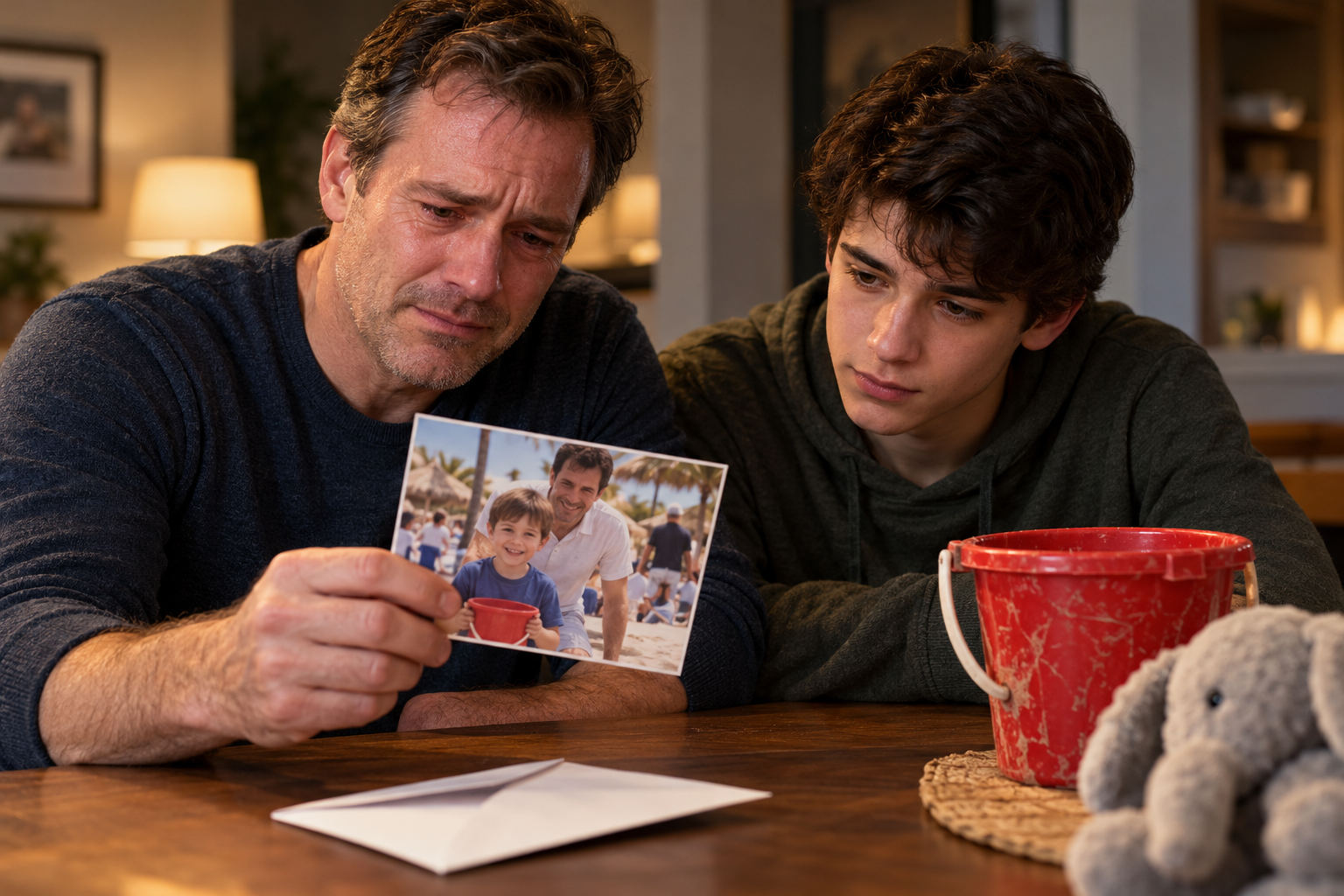
That evening, I took the photograph out of its drawer.
I placed it beside the red bucket.
The two objects looked almost ridiculous together.
One was a faded picture.
The other was a scratched piece of plastic.
Neither had any power to change the past.
Yet I couldn't put them away.
They were the closest things I had to a life with Matthew before everything went wrong.
I sat at the table and looked at the child in the photograph.
He had been six.
He had expected me to return.
I had expected to return too.
That was what made the memory so difficult.
There had been no reason for either of us to imagine that a short separation would become eleven years.
I wondered whether Robert had understood how much I trusted him.
Of course he had.
I had shown him.
I had handed him the responsibility of watching my son and walked away without hesitation.
I had treated his promise as something I did not need to question.
Perhaps that was what bothered me most.
I had trusted him because I believed our friendship meant something.
After Matthew disappeared, I had held on to that belief.
It had helped me accept Robert's presence during the years that followed.
Now the same belief made me question everything.
Ramirez called the following afternoon.
She asked me to come in.
I arrived carrying nothing.
No photograph.
No questions written on paper.
I wanted to speak from memory without using the picture as a shield.
Ramirez told me that she wanted to clarify several parts of my account.
She asked about my relationship with Robert before the disappearance.
I told her that we had been friends for years.
He had been present at important moments in my life.
He had known my family.
He had visited when Matthew was young.
He was someone I trusted with ordinary responsibilities.
Ramirez asked whether we had ever argued seriously.
I said we had disagreed from time to time, but nothing had happened that made me question the friendship.
She asked whether Robert had ever shown unusual interest in my movements or plans.
I thought about the questions he sometimes asked about my work schedule.
I had never considered them suspicious.
Friends asked about plans.
There had been no clear reason to think otherwise.
I told her that I had occasionally found him curious about where I would be, but I could not point to anything that proved it meant more than ordinary conversation.
Ramirez wrote that down.
I asked whether the questions mattered.
She said she was gathering details that might help clarify the timeline.
I accepted that answer.
I did not want to invent meaning where there might be none.
She then asked me to describe the period immediately after Matthew disappeared.
I told her how Robert had visited.
How he had brought food.
How he had sat with me when I couldn't talk.
How he had answered my calls when I needed someone to listen.
Ramirez asked whether I had ever felt that he discouraged me from asking questions about the disappearance.
I paused.
I remembered conversations in which Robert had told me that I needed to rest.
I remembered him saying that the search teams had done what they could.
I remembered him encouraging me to accept that there might never be an answer.
At the time, I had heard concern.
Looking back, those words made me uncomfortable.
They might have been the words of a friend who wanted me to stop suffering.
They might also have helped keep me from examining his own behavior.
I could not honestly say which.
"I don't know," I told her.
Ramirez nodded.
She did not ask me to choose between the possibilities.
When the meeting ended, I asked whether I could see Matthew again.
She said she would arrange another opportunity if he was willing.
I thanked her.
As I walked toward the exit, I thought about how strange the situation had become.
I was trying to rebuild a relationship with my son while questioning the man who had once helped me survive losing him.
The two things were connected.
I could not understand one without confronting the other.
That evening, Robert called me.
I watched his name appear on the screen.
For several seconds, I considered letting the call go unanswered.
Then I picked up.
He asked how I was doing.
I told him I was fine.
It was not true, but I did not want to begin the conversation with my feelings.
He asked whether I had heard anything more.
I said I had spoken with Ramirez.
He wanted to know what she had asked.
I told him that she was reviewing the events surrounding Matthew's disappearance.
He grew quiet.
Then he said that the whole thing was painful for everyone.
I looked at the photograph on the table.
"Everyone?"
He asked what I meant.
I told him that I had spent eleven years living with unanswered questions.
I had spent those years believing my son was dead.
Now I had learned that the story I accepted might not have been complete.
Robert said he understood.
I asked him whether he had ever wondered what happened to Matthew.
He answered that he had thought about it many times.
I asked whether there was anything he wished he had done differently that afternoon.
He did not answer immediately.
Then he said that everyone involved had done what they could.
I felt something close inside me.
It was the same kind of answer I had heard before.
A broad statement that sounded reasonable but told me very little.
I wanted to push him.
I wanted to demand a direct answer.
Instead, I told him that I needed some distance.
He asked whether I was blaming him.
I said I was trying to understand what had happened.
He told me that I shouldn't let suspicion destroy the years of friendship we had shared.
I sat silently.
Once, those words might have persuaded me to step back.
I might have apologized for raising the subject.
I might have promised that I would stop asking questions.
But I could no longer make that promise.
"I can't protect our friendship at the expense of finding out what happened to my son."
The words came out quietly.
Robert said nothing.
I ended the call.
My hands were shaking.
I had not accused him of anything.
I had not proved that he had lied.
But I had finally said something I should have said years earlier.
My need to preserve a friendship could not be more important than the truth about Matthew.
I placed the telephone beside the photograph.
Then I sat with the silence.
I did not know whether Robert was innocent.
I did not know what the investigation would reveal.
I only knew that I could no longer use the past as a reason to avoid asking questions.
Click here to continue reading: PART 11: My Son Had Returned, but Every Answer I Sought About His Disappearance Forced Me to Face What I Had Chosen Not to See
For Eleven Years, I Believed the Sea Had Taken Everything From Me, Until One Photograph Made Me Question the Man I Trusted
Part 10 of 20