The next time I met Matthew, I left the photograph at home.
It was harder than I expected.
For years, carrying that picture had made me feel close to him.
Without it, I felt exposed.
I had nothing to hold between us.
No image of him as a child.
No object that could explain why I had come.
Only myself.
I arrived early again.
Ramirez told me Matthew would join me shortly.
I sat by the window and watched people pass outside.
I wondered what Matthew had been doing during the eleven years I had spent mourning him.
I wondered whether he had celebrated birthdays.
Whether he had gone to school.
Whether he had ever looked at the ocean and wondered how he had come to be separated from his father.
I had no answers.
I had to accept that those years belonged to him as much as they belonged to the story of his disappearance.
When he entered, I stood.
He took the chair across from me.
This time, neither of us looked toward the door.
I asked whether he wanted to talk about the photograph.
He thought for a moment, then shook his head.
"Not today."
"All right."
I meant it.
I did not ask again.
We sat quietly until he asked me something I had not expected.
"What was I like when I was little?"
I felt my throat tighten.
I could have told him that he was wonderful.
I could have said that he was the happiest child in the world.
But those answers would have made him sound like a memory instead of a person.
So I told him about the things I remembered.
I told him that he woke early and asked too many questions.
I told him that he collected stones and shells.
I told him that he could spend a long time deciding which one belonged in his red bucket.
I told him that he sometimes refused to eat vegetables unless I pretended they were part of a game.
Matthew listened.
I described the stuffed elephant he had carried everywhere.
I told him how I had tried to repair its loose stitching.
He looked at me with an expression I couldn't quite read.
"Did you keep that too?"
"Yes."
The answer seemed to surprise him.
I explained that I had kept several things from his room.
I did not tell him that I had sometimes been unable to enter that room for months.
I did not tell him that I had once considered giving everything away because seeing it all at once had become unbearable.
Those memories were part of my grief.
They were not the only things he needed to know about his childhood.
Matthew looked at his hands.
"I don't remember much of that."
I nodded.
I had expected that answer, but hearing it still hurt.
The memories I had protected so carefully were not necessarily waiting inside him.
He had lived a different life.
He might never remember the things I remembered.
That did not make them less real.
It simply meant I could not use them as a bridge without his help.
I told him that he didn't have to remember anything for my memories to matter.
He looked at me.
I hoped the words did not sound like an attempt to make him feel guilty.
I wanted him to understand that he was not responsible for making my grief easier.
We talked a little longer.
Then he asked about Robert.
The name changed the atmosphere immediately.
I had known the question would come.
I had been thinking about Robert since the first meeting, and I had still not found a way to explain what I believed.
I told Matthew that Robert had been my friend for years.
I told him that I had trusted him.
I told him that he had been responsible for watching Matthew when I stepped away to deal with the excursion.
Matthew remained still.
I explained that after the disappearance, Robert had said Matthew had vanished during the confusion.
He had spoken about the dangerous water.
He had told me that people had tried to help.
I told Matthew that I had believed him.
Then I stopped.
I did not want to make excuses for myself.
I did not want to turn the conversation into a list of reasons why I had trusted Robert.
The simple truth was that I had trusted him, and I had not questioned him enough.
Matthew asked whether I still believed Robert had done nothing wrong.
I took a breath.
"I don't know what happened yet."
He looked away.
"But I don't think I should have accepted every answer he gave me."
Matthew said nothing.
I wondered whether that answer disappointed him.
Perhaps he wanted me to accuse Robert.
Perhaps he wanted me to defend him.
I could not know.
I could only tell the truth as I understood it.
I told Matthew that I was trying to separate what I remembered from what I had assumed.
I remembered Robert standing near the pool.
I remembered the confusion on the beach.
I remembered the search.
I remembered the explanations.
What I did not know was why Robert had behaved as he did.
I had spent years filling that gap with the explanation that hurt the least.
I could no longer do that.
Matthew listened without interrupting.
When I finished, he looked at the table.
I waited.
He did not ask another question.
For once, I did not feel compelled to fill the silence.
We sat together until Ramirez came to tell us that our time was nearly over.
I stood.
Matthew stood too.
I wanted to ask when I could see him again.
Instead, I waited for him to speak.
He said that he would be willing to meet another day.
I nodded.
"Whenever you're ready."
He looked at me briefly.
Then he left the room.
I remained where I was for a moment.
I had spent years believing that the truth would arrive as a single answer.
I imagined someone explaining what had happened to Matthew, and all the confusion would disappear.
But the truth was not arriving that way.
It was coming in pieces.
A photograph.
A remembered gesture.
A question about Robert.
A pause that told me more about what I didn't know than any answer could.
I had to learn how to live with those pieces without forcing them into a story that suited me.
Outside, I called Ramirez.
I asked whether there had been any new information about Robert.
She said that the matter was still being examined.
I told her I wanted to cooperate with whatever questions needed answering.
She said she would contact me when there was something more she could share.
I thanked her and ended the call.
On the way home, I thought about the photograph again.
I could see Robert standing behind Matthew.
I could see my son holding the red bucket.
I could see myself walking away, believing that everything was safe because a trusted friend had promised to watch him.
That promise had once been enough.
Now I understood how little I had known.
I reached home and went to the room where I had kept Matthew's belongings.
The red bucket sat where I had left it.
I picked it up and examined the old scratch along its side.
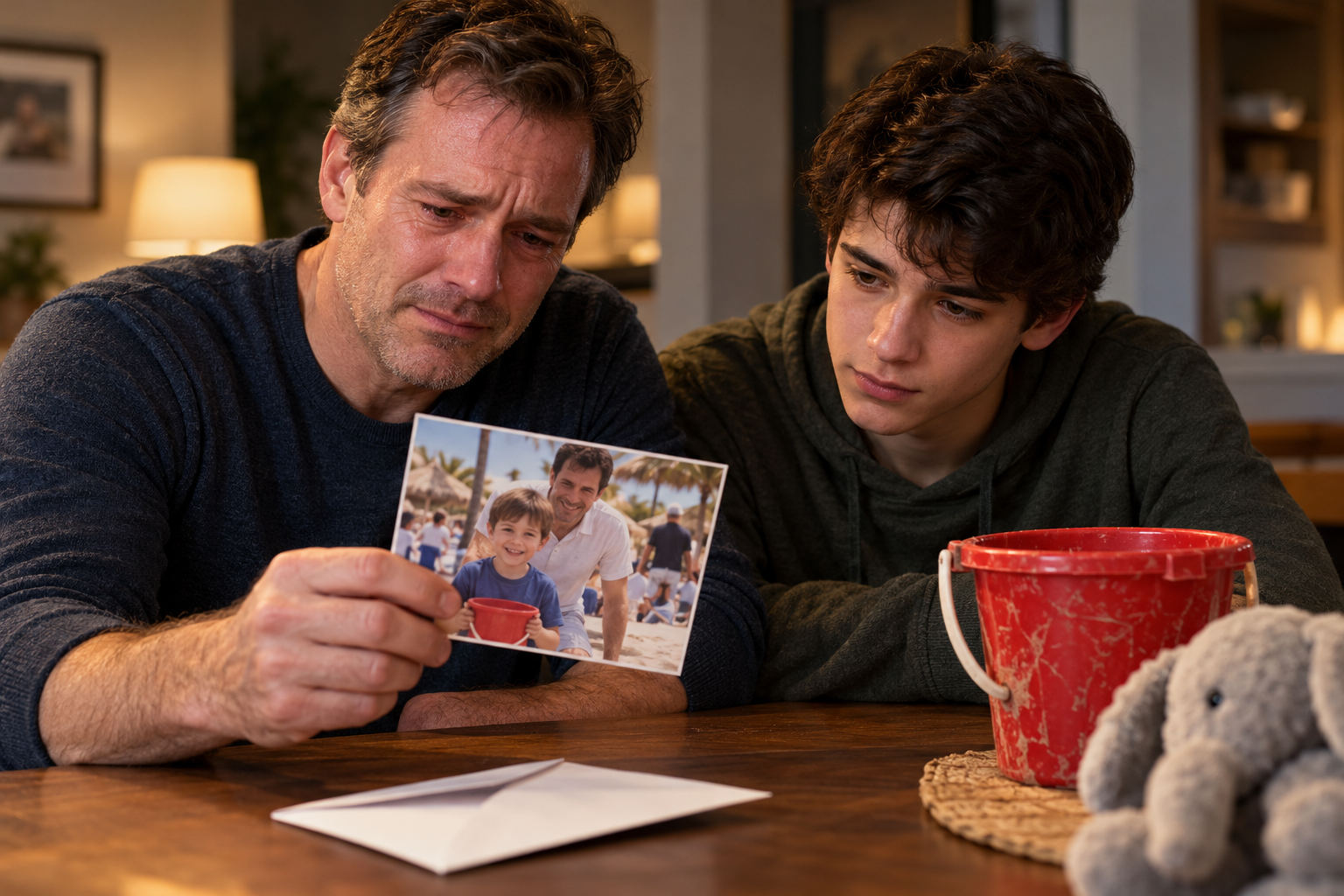
Then I set it on the table beside the photograph.
For years, those two objects had represented everything I had lost.
Now they represented something else.
The photograph reminded me that I had trusted Robert.
The bucket reminded me that Matthew had been a real child, not just the boy in the story I had repeated to myself.
And the seventeen-year-old who had returned reminded me that I had a responsibility to learn who my son was now.
I could not undo the past.
I could stop pretending I understood it.
That night, I put the photograph away.
I left the red bucket on the table.
I wanted it ready if Matthew ever asked to see it.
For the first time in eleven years, I was no longer preparing for a funeral that had never taken place.
I was preparing to meet my son again.
Click here to continue reading: PART 9: I Had Finally Learned to Listen to My Son, but the Questions About Robert Were Becoming Impossible to Keep Outside Our Conversations
For Eleven Years, I Believed the Sea Had Taken Everything From Me, Until One Photograph Made Me Question the Man I Trusted
Part 8 of 20