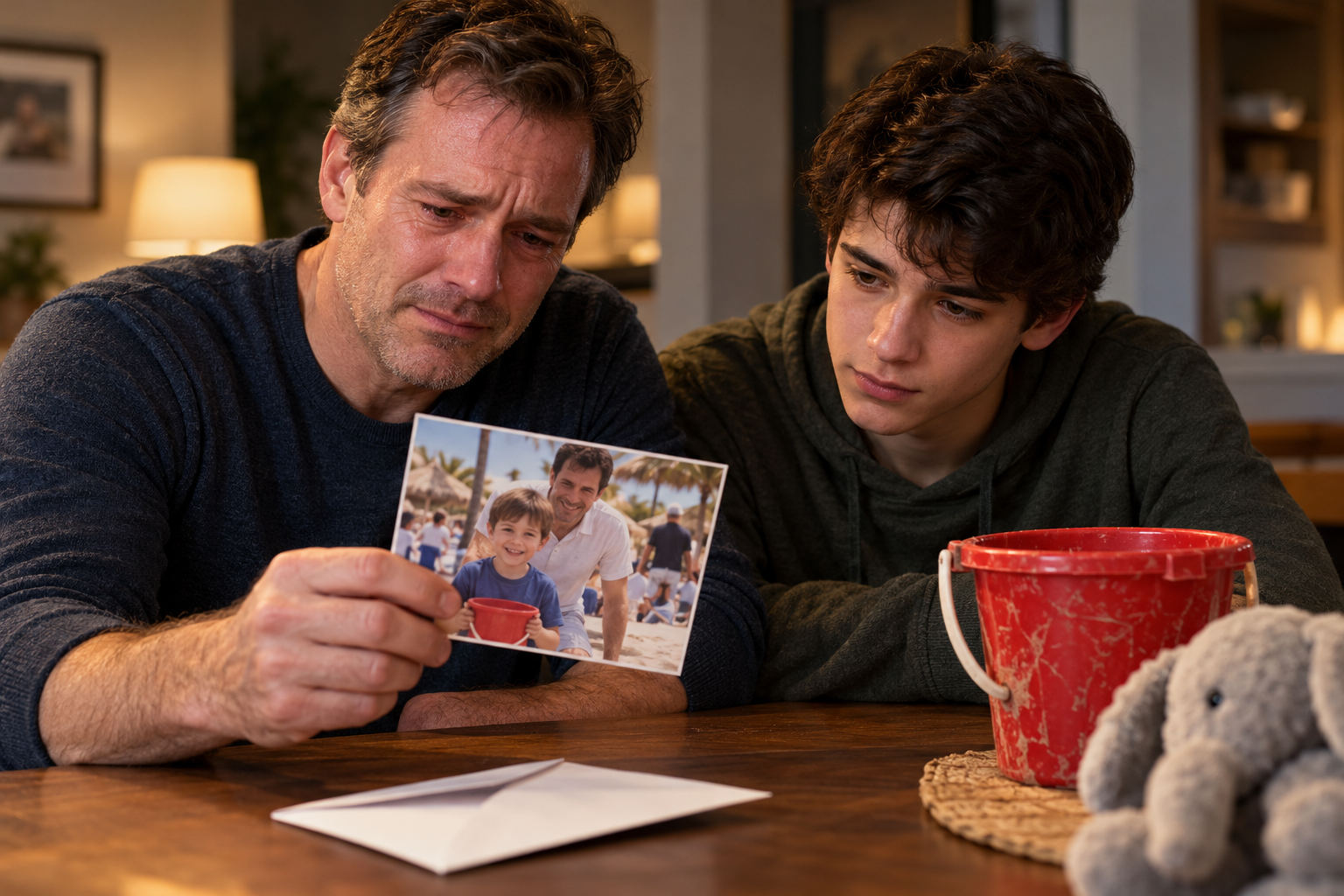
I left the red bucket on the kitchen table for three days.
Every morning, I saw it before I made coffee.
Every evening, I passed it on my way to bed.
It looked out of place there.
For years, I had kept it with Matthew's other belongings, away from the ordinary things I used every day.
Now I wanted it somewhere I could see it.
I wanted to remember that my son had been a real child with ordinary habits, not just the boy I had lost on a beach.
I also wanted to be ready if he asked about it.
He hadn't asked yet.
I was learning not to turn every possibility into an expectation.
On the fourth day, Ramirez called.
She asked whether I could come in for another meeting.
I agreed immediately.
Then I stopped myself from asking whether Matthew would be there.
I wanted to see him, but I didn't want every conversation with Ramirez to become a negotiation for more time with my son.
She told me that there were questions about the original account of the disappearance that needed another look.
I asked whether those questions concerned Robert.
She said they did.
I sat down.
For eleven years, I had been afraid to hear that name connected to anything worse than a mistake.
Now I was afraid of what it might mean if his part in the story had never been properly understood.
I arrived at the building that afternoon with the photograph in my pocket.
I had told myself I would leave it at home.
I had even put it in a drawer the night before.
But when I left the house, I went back for it.
I couldn't explain why.
Perhaps I was still trying to understand the difference between what the photograph showed and what I had believed it meant.
Ramirez led me into the same room where we had first spoken.
The chairs were arranged around the table.
A folder lay in front of her.
I sat down and waited.
She asked me to describe Robert's behavior after Matthew disappeared.
I gave her the account I had given before.
I told her that he had been near the pool when I returned.
I told her that he had not appeared to be searching.
I explained that I had assumed he was in shock.
Ramirez asked whether I had ever seen him react that way to an emergency before.
I thought about it.
"No."
She asked whether he had explained why he was standing there.
I remembered the conversations that followed.
Robert had talked about the confusion.
He had mentioned the water.
He had spoken about the efforts to find Matthew.
But I could not remember him offering a clear explanation for why he had been away from the search at that moment.
I had never pressed him on that point.
Ramirez made a note.
I watched her write.
The movement of her pen seemed painfully ordinary.
I had expected that learning more about my son's disappearance would feel dramatic.
Instead, it felt like sitting in a quiet room while someone wrote down details I should have examined years ago.
Ramirez asked about the photograph.
I took it from my pocket and placed it on the table.
She studied the image.
I pointed out Matthew's red bucket.
Then I pointed to Robert.
I told her that I remembered the conversation before I left the children's club.
Robert had assured me that he would keep an eye on Matthew.
I had accepted that promise without hesitation.
I had known him for years.
I had no reason to think he would let anything happen to my son.
Ramirez asked me whether I remembered Robert's exact words.
I couldn't.
I remembered the confidence in his voice.
I remembered feeling relieved that I could step away for a little while.
I remembered believing that everything was under control.
The details of the conversation had faded.
The feeling had not.
I told Ramirez that I had spent years blaming myself for walking away.
She listened.
Then she asked whether I had ever considered that Robert might have known more than he told me.
I stared at the photograph.
"Not seriously."
The admission embarrassed me.
I had considered it in brief, frightened moments.
Then I had pushed the thought away.
Robert had been there for me afterward.
He had visited.
He had listened.
He had helped me through the worst period of my life.
I had treated those things as evidence that he could not have been involved in anything harmful.
I understood now that they proved nothing about what had happened on the beach.
Ramirez did not accuse him.
She did not tell me what to believe.
She simply asked me to describe what I remembered without trying to explain it.
That was harder than I expected.
I had spent eleven years explaining everything.
The ocean had been rough.
The beach had been crowded.
People had been frightened.
Robert had been shocked.
Each explanation had helped me put one more part of the afternoon away.
Without those explanations, the memories felt unfinished.
I told Ramirez what I remembered.
I told her what I did not remember.
I tried not to fill the gaps.
When the meeting ended, I felt exhausted.
Not because I had learned something new.
Because I had finally admitted how much I had never known.
Before I left, I asked whether Matthew would be available for another meeting.
Ramirez said she would check.
I thanked her.
Then I returned home.
The red bucket was still on the table.
I picked it up and carried it to the cupboard, then stopped before putting it away.
I had kept it because I couldn't bear to lose another thing connected to my son.
Now I wondered whether I had been treating every object as if it could answer a question.
The bucket couldn't tell me what had happened.
The photograph couldn't tell me why Robert had stood near the pool.
Only the people who knew more than I did could help explain those things.
I put the bucket back on the table.
That evening, I called Robert again.
I had rehearsed the conversation several times.
Each time, I imagined myself asking him directly what he had done.
Each time, I imagined him denying everything.
I knew I had no new information that would justify an accusation.
I also knew that I could no longer pretend the questions did not exist.
When he answered, I asked whether he remembered the day Matthew disappeared.
He was quiet for a moment.
"Of course I remember."
I asked him whether he remembered standing near the pool when I returned.
Another pause followed.
He said the afternoon had been chaotic.
I told him I remembered that.
I asked why he had been standing away from the search.
He said he had been trying to understand what was happening.
It was a reasonable answer.
It was also an answer that left me where I had started.
I asked whether there was anything about that afternoon he had never told me.
He wanted to know why I was asking.
I told him that the case had come up again.
He asked who had contacted me.
I did not give him a name.
He said I was upsetting myself over something that had happened eleven years earlier.
I looked at the photograph on the table.
"I'm trying to understand what happened to my son."
Robert said he understood.
But I no longer found that reassuring.
We ended the call without an argument.
I sat alone in the kitchen.
The red bucket stood near the photograph.
For the first time, I saw how much of my life had been shaped by my desire to preserve a version of the past that I could survive.
I had wanted Robert to be innocent because I needed to believe that I had trusted the right person.
I had wanted the sea to be responsible because the sea could not look back at me.
Neither desire was evidence.
And neither could tell me what had happened to Matthew.
Click here to continue reading: PART 10: Robert Still Spoke Like the Friend I Remembered, but His Familiar Voice No Longer Made Me Feel Safe
For Eleven Years, I Believed the Sea Had Taken Everything From Me, Until One Photograph Made Me Question the Man I Trusted
Part 9 of 20