The next time I spoke with Robert, I did not plan to discuss the past.
I wanted to know whether we could have an ordinary conversation without the disappearance sitting between us.
For years, our friendship had been shaped by what happened to Matthew.
Robert had become the person who helped me endure the loss.
Now I could no longer accept his comfort without wondering whether his account of that afternoon was complete.
I had to find out whether there was anything left of the friendship outside that question.
I called him on a quiet evening.
He answered after several rings.
We spoke briefly about work and the ordinary business of life.
For a few minutes, I felt the familiarity return.
Then Robert asked whether I had heard anything new.
I told him I had spoken with Ramirez.
He wanted to know what she had said.
I explained that the investigation was continuing.
He sighed.
He said he hoped I wasn't putting myself through unnecessary pain.
I looked toward the shelf where I had placed the red bucket.
"I'm trying to understand what happened."
He told me that there might never be a complete answer.
I knew that was possible.
I had lived with that possibility for eleven years.
But I no longer wanted to accept it before the questions had been properly examined.
"I need to know that I've done everything I can."
Robert was quiet.
Then he said he understood.
I wondered whether he did.
We ended the call without arguing.
I sat at the table afterward and thought about the conversation.
I had not learned anything new.
I had not proved that Robert was lying.
But I had noticed how quickly he returned to the idea that I should stop searching.
Perhaps he genuinely wanted me to be free of the pain.
Perhaps he feared what continued questioning might uncover.
I could not know which possibility was true.
I wrote both down in my notebook.
Then I closed it.
I did not want to spend the rest of my life inventing motives for every sentence Robert spoke.
I wanted facts.
The next morning, Ramirez called.
She asked me to clarify something about the photograph.
I told her that I had it again.
She asked whether I could bring it to our next meeting.
I agreed.
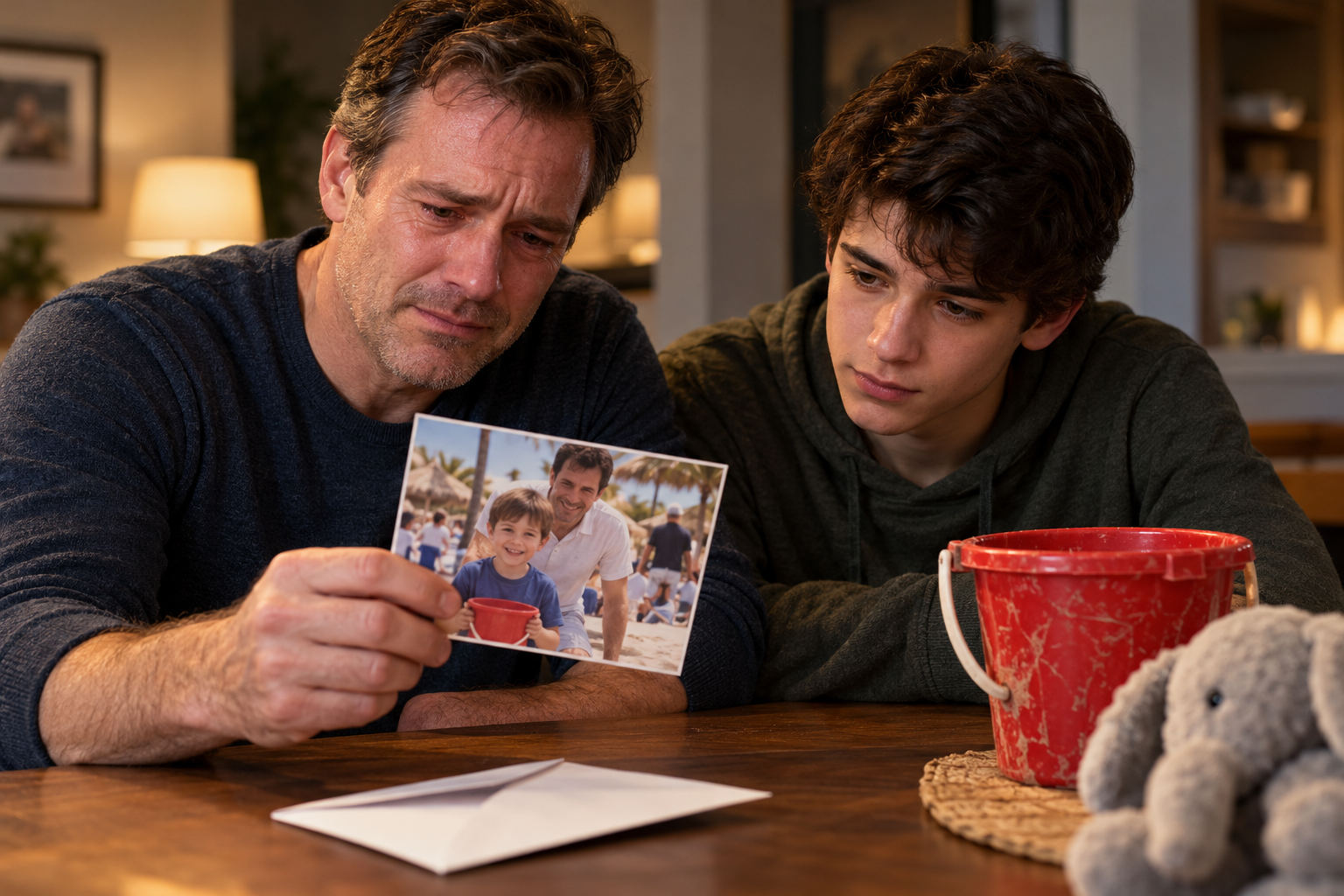
I placed it in the same envelope Matthew had returned.
When I arrived, Ramirez examined the picture carefully.
She asked me to identify the people in it.
I pointed out Matthew and Robert.
I explained where the photograph had been taken.
She asked whether I remembered who had taken it.
I did not.
That was another small gap in my memory.
I had always been so focused on the fact that Robert was standing behind Matthew that I had never thought much about the person holding the camera.
Ramirez asked whether the photograph had been taken before or after I arranged for Robert to watch my son.
I said I believed it had been taken during the same period, but I could not establish the exact order of events from the picture alone.
She wrote that down.
I watched her examine the image once more.
There was nothing unusual about it.
No visible sign of danger.
No message hidden in the background.
No evidence that could explain what happened afterward.
It was an ordinary photograph of an ordinary afternoon.
I had to stop asking it to be more than that.
Ramirez returned it to me.
I placed it in the envelope.
Then I asked whether the renewed examination had changed anything about the understanding of the case.
She told me she could not yet give me a final answer.
I nodded.
I was disappointed, but I did not argue.
I had learned that pressing someone for certainty did not make certainty appear.
After the meeting, I called Matthew.
I asked whether he wanted to have dinner together sometime.
He considered it.
Then he agreed.
We chose a day and a place.
When I ended the call, I felt something I had not expected.
Nervousness.
I had spent years imagining the day I would see my son again.
Now I was nervous about choosing a restaurant and deciding what to talk about over dinner.
It was almost funny.
I had once believed that finding him would solve the most difficult part of my life.
Instead, I was learning how to be a father to a seventeen-year-old who had become a stranger to me.
I wanted to get it right.
I knew I couldn't.
The dinner was quiet at first.
We looked at the menu.
Matthew asked what I usually ordered.
I told him.
He chose something different.
We spoke about the food, the place, and the people around us.
For a while, the disappearance did not come up.
I felt relieved.
Then Matthew asked whether I still spoke to Robert.
I told him that I had spoken with him recently.
He asked whether Robert had explained what happened.
I said no.
Matthew looked down at his plate.
I waited.
He asked whether I believed Robert was hiding something.
I thought carefully before answering.
"I believe there are questions he hasn't answered."
Matthew looked at me.
"Is that different?"
"Yes."
I explained that I could not know whether he was deliberately hiding something or whether there were details he could not remember clearly.
I did not want to confuse my suspicion with proof.
Matthew seemed to consider that.
Then he nodded.
We returned to our meal.
I was grateful that he had asked.
I was also grateful that I had not tried to give him an answer I didn't have.
When dinner ended, I walked with him toward the place where we were separating.
He asked whether we could meet again soon.
I told him yes.
He nodded.
We said goodbye.
On the way home, I thought about the two questions I had been carrying for eleven years.
Where was Matthew?
And what had happened to him?
One of those questions had finally been answered.
The other remained.
I could not force the remaining question to disappear simply because I had found my son.
But I could stop letting it consume every moment we shared.
I wanted to know the truth about Robert.
I also wanted to know Matthew.
Those were not competing responsibilities.
I could pursue one without sacrificing the other.
That night, I put the photograph in the drawer beside the notebook.
I closed the drawer.
Then I went to bed without taking either one out again.
Click here to continue reading: PART 19: I Had Found the Son I Thought the Sea Had Taken, and I Finally Understood That Love Could Not Tell Me What the Evidence Had Yet to Reveal
For Eleven Years, I Believed the Sea Had Taken Everything From Me, Until One Photograph Made Me Question the Man I Trusted
Part 18 of 20