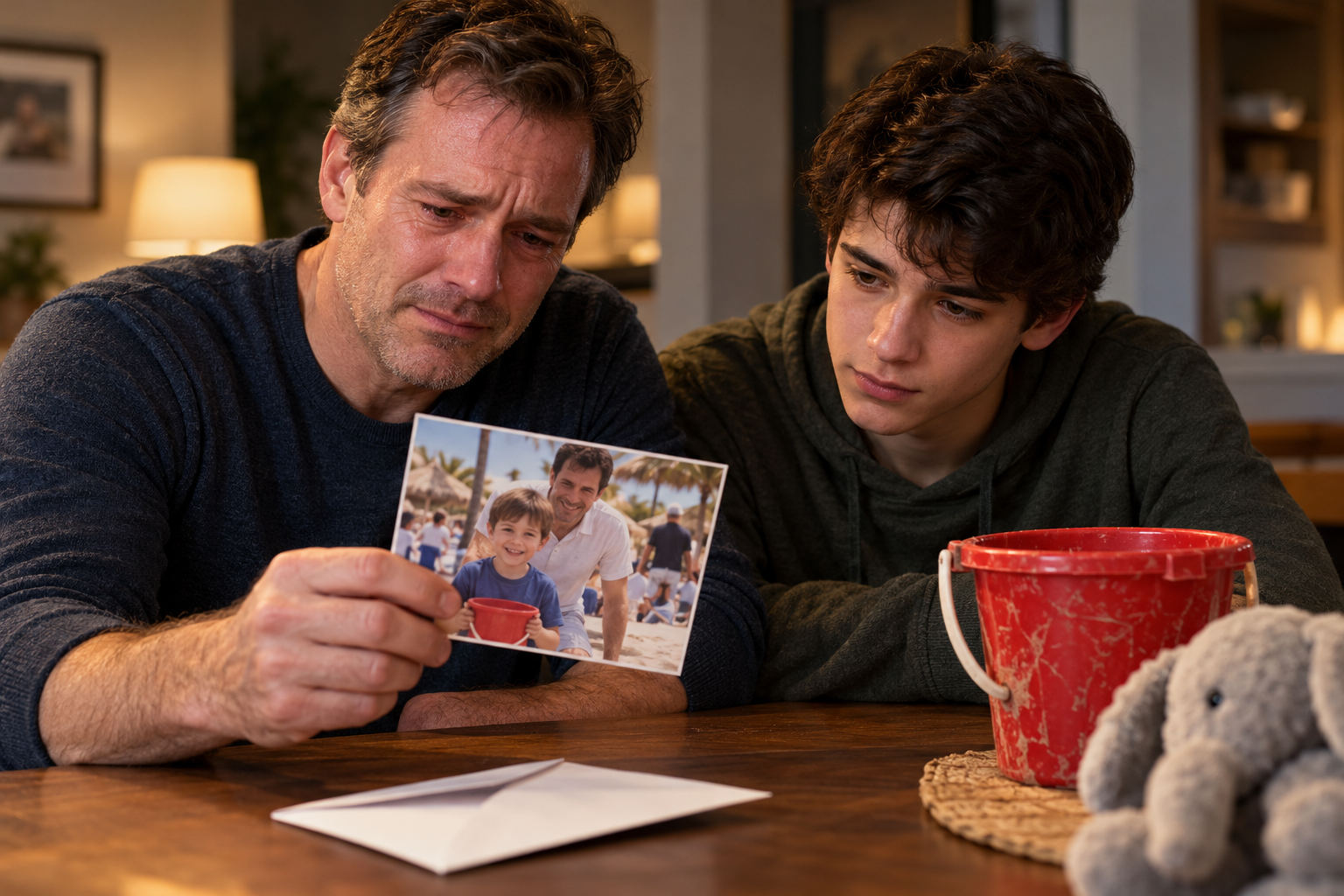
The photograph remained in the drawer for several weeks.
Matthew had looked at it again and returned it to me.
Neither of us had found an explanation in the image.
It showed a little boy, a red bucket, and a man I had once trusted without hesitation.
It showed an ordinary moment.
I had spent years believing that the photograph contained the last piece of a life I could never recover.
Now I understood that it was only one part of a story that neither of us fully understood.
I kept it because it mattered.
I stopped expecting it to answer questions.
The investigation continued.
Ramirez remained careful about what she could tell me.
There were conversations, questions, and details that still needed examination.
I did not receive the complete explanation I had wanted.
I had to accept that the truth might take longer than I could bear.
I had spent eleven years living with an absence.
I could survive a period of uncertainty without allowing it to take everything else from me.
That was what I told myself, anyway.
Some days were harder than others.
I still thought about Robert.
I still remembered the way he had stood near the pool while people searched for Matthew.
I still remembered the explanations he had given me.
I still wondered why I had accepted those explanations without demanding more.
I had not found a way to make those questions disappear.
I had only stopped treating my suspicions as answers.
That mattered.
It meant I could keep looking for the truth without pretending I already knew it.
It also meant I could stop defending Robert simply because he had once been my friend.
I had no obligation to protect an old friendship from honest questions.
I had an obligation to be truthful about what I remembered.
I had an obligation to listen when new information came to light.
And I had an obligation to avoid accusing someone of things I could not establish.
For the first time, those responsibilities no longer seemed to contradict one another.
My relationship with Matthew continued in small steps.
We met when he was willing.
Sometimes we talked for an hour.
Sometimes we ran out of things to say after twenty minutes.
I learned that he did not always want to discuss his childhood.
I learned that asking him too many questions could make him withdraw.
I learned that he sometimes needed time to think before answering even an ordinary question.
I stopped treating those silences as signs that I had done something wrong.
Sometimes a silence was just a silence.
That was a lesson I should have learned long before.
One afternoon, Matthew asked whether he could visit my house.
I told him he could.
I tried to keep my voice calm.
After we ended the call, I walked through the house and noticed everything I had begun to take for granted.
The table.
The chairs.
The shelf where the red bucket stood.
The drawer where I kept the photograph and notebook.
I wondered whether Matthew would feel comfortable there.
I wondered whether he would want to see the things I had kept.
Then I reminded myself that I did not need to prepare a museum of his childhood.
I only needed to make room for him.
When he arrived, I opened the door before he could knock again.
He stood outside for a moment, looking at me.
I stepped aside.
He came in.
I showed him the kitchen and the living room.
I did not immediately lead him toward the shelf.
I let him look around.
He asked where I kept the photograph.
I took it from the drawer.
He studied it once more.
Then he placed it back in the envelope.
He looked toward the shelf.
"Is that the bucket?"
I nodded.
He walked over and picked it up.
He turned it in his hands, examining the scratches.
I stood nearby without speaking.
He looked at the faded mark on the bottom.
Then he put the bucket back.
"I think I remember carrying it."
I felt my heart tighten.
I wanted to ask what else he remembered.
I wanted to know whether the image had brought back something important.
But I did not rush him.
He looked at me.
"It's not much."
"It doesn't have to be."
He nodded.
We sat down at the kitchen table.
I made him something to drink.
He asked about the stuffed elephant.
I told him it was still with his other belongings.
He asked whether he could see it another time.
I said yes.
We talked about ordinary things for the rest of the visit.
When he left, I did not ask him whether he felt at home.
I did not ask him whether he wanted to return.
I simply thanked him for coming.
He said he would see me again.
I closed the door and stood in the hallway.
I had imagined this kind of moment for eleven years.
In my imagination, Matthew had returned to a house that had been waiting for him.
He had recognized his belongings.
He had understood that I had never stopped loving him.
Real life was quieter.
He had visited.
He had looked at a bucket.
He had asked about a toy.
He had left.
And he had said he would see me again.
That was enough.
I went into the kitchen and looked at the red bucket.
I had once believed that keeping it untouched would preserve the child who had disappeared.
Now I understood that the bucket did not have to remain exactly where it had been for my love to remain real.
I could put it on a shelf.
I could move it.
I could let Matthew decide whether he wanted to keep it.
The object was not the relationship.
The photograph was not the relationship.
The years of grief were not the relationship either.
The relationship was what we were building now.
It was imperfect.
It was uncertain.
It was still ours.
I put the bucket back on the shelf and closed the drawer containing the photograph.
Then I opened the notebook.
I read the pages where I had written down my memories of Robert.
I had recorded what I remembered and what I could not establish.
I had not written a final conclusion because I did not have one.
I left the notebook open for a moment.
Then I closed it.
I would continue cooperating with Ramirez.
If new information emerged, I would listen.
If Robert had more to say, I would hear him.
I would not pretend that our friendship made him incapable of wrongdoing.
I would not pretend that my suspicions proved he had done something wrong.
I would wait for the facts.
That was all I could do.
The following week, Matthew and I met again.
We spoke about his plans and the things he wanted to do.
I listened more than I talked.
Sometimes I wanted to interrupt with advice.
Sometimes I wanted to tell him how much I had missed.
I held back when I thought the words would make the conversation about me.
He was not responsible for healing the years I had lost.
He was not responsible for making my grief easier to carry.
He was not responsible for proving that I had been a good father.
He was my son.
I wanted to know him.
That had to be enough.
Before we parted, he asked whether I would be available the following week.
I told him I would.
He nodded and walked away.
I watched him until he disappeared from view.
Then I returned to my car.
For eleven years, I had believed the ocean had taken my son.
I had mourned a child without a grave.
I had blamed myself for trusting a friend.
I had accepted an explanation because I could not bear to live without one.
Now my son was alive, and I was learning how much of the story remained unknown.
I still wanted answers.
I still wanted to understand what happened that afternoon.
I still wanted to know whether Robert had told me everything he knew.
But I no longer believed that I had to solve the past before I could live in the present.
The sea had never given me an answer.
It had only become the place where my questions began.
My son had come home.
He was seventeen, not six.
He was not the child I had spent eleven years remembering.
He was a young man with his own thoughts, his own silences, and his own life.
I could not give him back the years he had lost.
I could not promise that our relationship would ever become easy.
I could not change the choices I had made before he disappeared.
I could choose what I did next.
I could keep listening.
I could keep showing up.
I could tell the truth about what I knew and admit what I did not.
And I could stop letting an unanswered question decide whether I was allowed to be happy that my son was alive.
That evening, I made coffee and sat at the kitchen table.
The red bucket stood on the shelf.
The photograph rested in the drawer.
The notebook was closed.
For once, I did not take any of them out.
I sat quietly and thought about the next time I would see Matthew.
I did not know what we would talk about.
I did not know whether the investigation would give us the answers we wanted.
I did not know what would happen with Robert.
But I knew that my son and I had another day ahead of us.
After eleven years, I had finally learned to stop treating that as something too small to matter.
The End
Read more original stories on Feel Every Story.
For Eleven Years, I Believed the Sea Had Taken Everything From Me, Until One Photograph Made Me Question the Man I Trusted
Part 20 of 20